Why did I do that?
I don’t ever manage to get as much time in the studio as I would like. My current work situation allows me only a single day per week that I can devote properly to painting or drawing, and although I like to fit shorter sessions in as often as possible, the inertia and hassle involved in setting up and tearing down my acrylic painting equipment means that I only bother with it when I have a fair chunk of time.
I’ve mentioned a lot in this blog that I feels it’s essential to be self-critical if one wants to improve at painting. In the spirit of constant improvement, I was trying this week to get my process a bit more refined. So this week’s studio time was devoted to process, rather than end result.
Let me explain what I was trying to do. It’s an accepted strategy in acrylic (or oil) painting to work from thin to thick, dark to light. What does this mean? Essentially, the idea is to block in large shapes with thinner (almost wash-like) layers of paint, starting with the dark bits. Subsequent layers can get thicker and more opaque, working towards lighter details. What I find myself doing, more often than not, is diving in to the “thick stuff” far too early, getting frustrated, but having too much texture on the painting to really go in a different direction. Remembering that acrylic paint dries much faster than oils, it’s often not very helpful to go too thick to soon, as the ridges and bumps of the dried-on paint will limit what strokes can be made on the canvas at a later stage.
This latest painting was done using multiple layers, but with very thin washes in the first instance - you can easily see the texture of the canvas under the paint, especially in the sky area. So from that point of view, at least, it was a useful painting session.
I ended up painting over this one and I’m not sure why. Sure it’s not perfect, but I could have worked on it to get it back to something that I would ultimately be happy with. I think I felt that it wasn’t sufficiently loose to be a “loose” painting, nor sufficiently controlled to be a more representational work. I’ve also got this hang-up about being able to see brush marks in my paintings - I love loose paintings (when other people do them), but I find the visibility of brush marks in my own work to be an annoyance. Why? I don’t know. Anyway, I painted over the whole thing with some burnt umber, so what could have been a reasonable painting is now more like a square cowpat.
There’s something about this particular location (Old Harry Rocks, near Studland, Dorset) that draws me back time and again, so I think I’ll have another go next week.
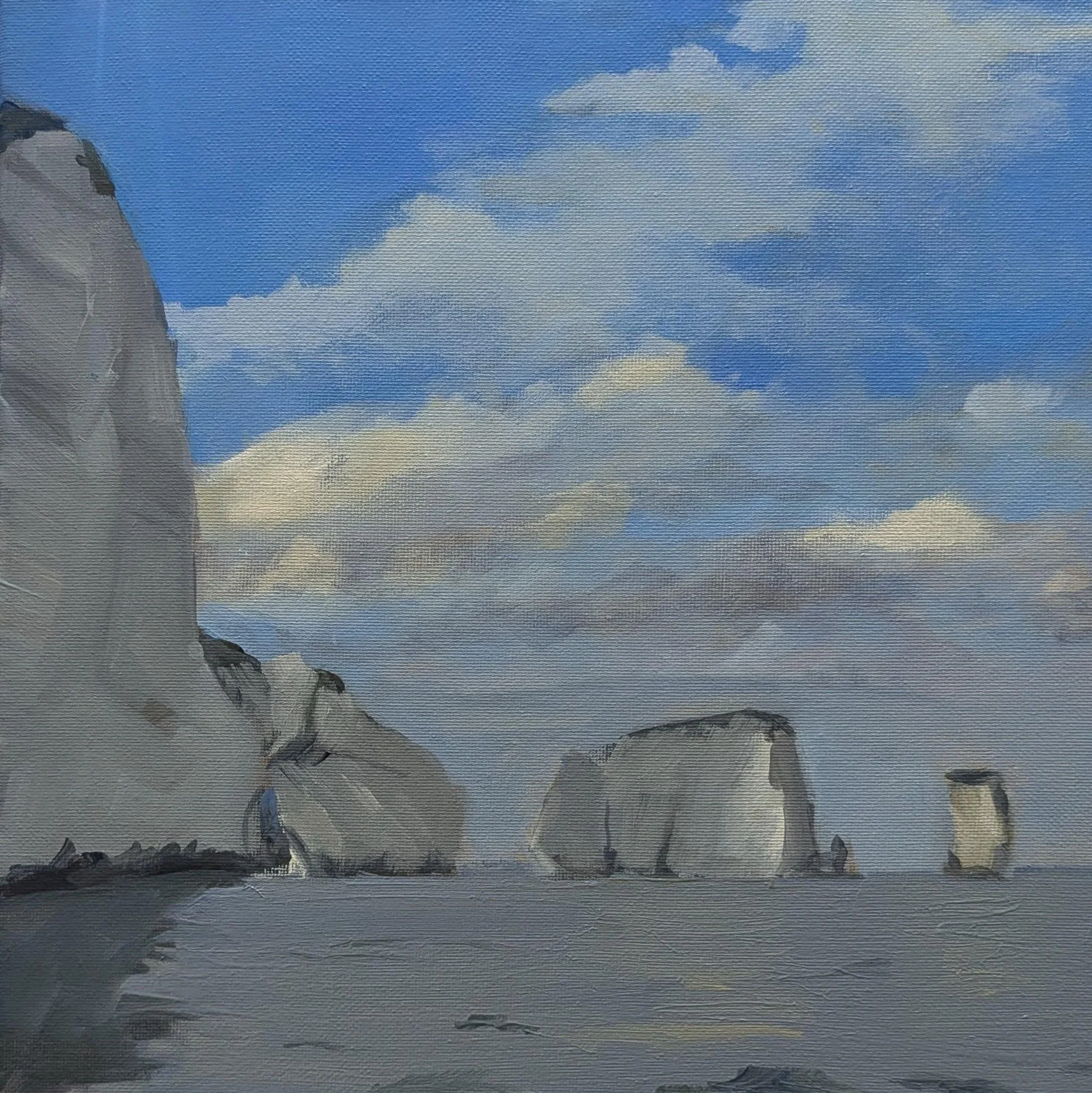
Old Harry Rocks. Acrylic on canvas.
